
The Dens → Wolves
WOLF SCOUTS
Curiosity becomes confidence
Second grade
Wolf Scouts are energetic, imaginative, and ready to do more for themselves. Second graders begin building genuine outdoor skills, practicing responsibility, helping their community, and learning how their choices affect other people.
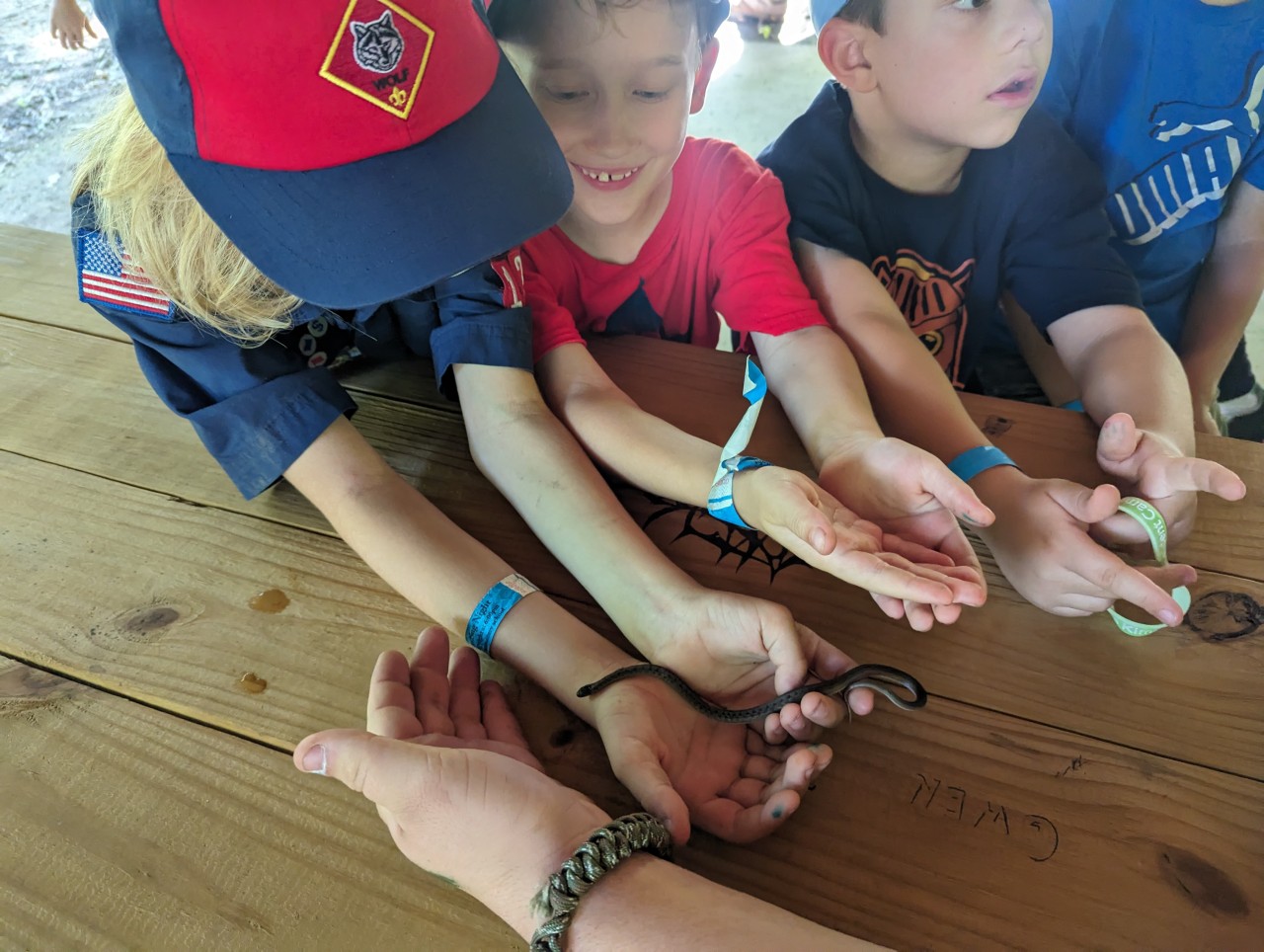
The Wolf year balances active fun with growing independence. Scouts still receive plenty of guidance, but they are encouraged to pack their own gear, solve problems, explain their thinking, and take pride in contributing to the den.
AT A GLANCE
Grade: Second grade
Recognition: Wolf rank badge and adventure loops
Advancement: Six required Adventures and at least two electives
Parents are important partners in the program, but Wolf Scouts are no longer required to have an individual adult partner beside them at every meeting.
REQUIRED WOLF ADVENTURES
Character and leadership
Bobcat
Wolves get to know their den, recite the Scout Oath and Scout Law, create a den code of conduct, demonstrate Cub Scout signs and courtesies, and share how they have done their best.
At this level, Scouts begin thinking not only about what the Scout Law says, but also how its ideas can guide the way a group treats one another.
The outdoors
Paws on the Path
Wolves assemble the Cub Scout Six Essentials, use the buddy system, select suitable clothing and footwear, learn the Outdoor Code and Leave No Trace principles, and take an outdoor walk.
They also observe animals and signs of wildlife. The Adventure helps Scouts move from simply being outside to being prepared and attentive outdoors.
Personal fitness
Running With the Pack
Wolves explore colorful, nutritious foods, active exercise, personal workouts, relaxation, hygiene, sleep, and their readiness to participate in den and pack activities.
Scouts begin understanding fitness as a combination of movement, nutrition, rest, and personal care—not simply who can run the fastest.
Citizenship
Council Fire
Council Fire helps Wolves understand what it means to be a good neighbor. They learn about the United States flag, connect points of the Scout Law to citizenship, create models of a home and neighborhood, and participate in service.
The Adventure brings the idea of community down to a scale second graders can see and understand.
Personal safety
Safety in Numbers
Wolves learn practical strategies for staying safe with other people, online, at home, and during activities. They practice recognizing boundaries, communicating with trusted adults, and using the buddy system.
The emphasis is on awareness, speaking up, and knowing that asking for help is a sign of good judgment.
Family and reverence
Footsteps
Wolves explore their family’s faith traditions or guiding beliefs, identify meaningful celebrations, create a related craft or work of art, and participate with their family in an appropriate service, gathering, or expression of reverence.
Families guide this Adventure according to their own beliefs and traditions.
WOLF ELECTIVE ADVENTURES
Wolf electives allow Scouts to pursue outdoor skills, science, history, sports, service, and hobbies:
- A Wolf Goes Fishing — Learn fishing basics and take a fishing trip.
- Let’s Camp — Prepare for and participate in Cub Scout camping.
- Race Time — Build or race while learning sportsmanship and design.
- Pedal with the Pack — Improve cycling skills and bicycle safety.
- Spirit of the Water — Practice swimming and water safety.
- Champions for Nature — Learn about conservation and complete an environmental activity.
- Digging in the Past — Explore fossils and prehistoric life.
- Computing Wolves — Investigate computers and computational thinking.
- Air of the Wolf — Experiment with air, flight, and motion.
- Code of the Wolf — Discover patterns, codes, and mathematical thinking.
- Adventures in Coins — Explore money, coins, history, and collecting.
- Cubs Who Care — Learn about differing abilities and inclusion.
- Finding Your Way — Practice navigation and direction-finding.
- Germs Alive! — Conduct experiments about germs and hygiene.
- Paws of Skill — Practice sports skills and sportsmanship.
WHAT A WOLF MEETING FEELS LIKE
Wolf meetings are busy and hands-on. Scouts may rotate among activity stations, practice a skill in pairs, conduct a small experiment, build a model, prepare for a walk, or work together on a service project.
Leaders begin asking more questions instead of supplying every answer:
- “What do you think we should bring?”
- “How could we make this safer?”
- “What would you change next time?”
That process helps Wolves learn to think and act more independently.
WHAT PARENTS SHOULD EXPECT
Parents support Wolf advancement by helping with family requirements, transportation, outdoor events, and occasional at-home activities.
The most helpful approach is to coach rather than complete:
- Let the Scout pack their own day bag, then review it together.
- Allow imperfect projects that genuinely belong to the child.
- Ask the Scout to demonstrate skills instead of simply confirming that they know them.
- Help them follow through on service and household responsibilities.
- Keep the den leader informed when family requirements are completed.
BY THE END OF THE WOLF YEAR
Wolves often emerge with:
- Better outdoor preparation habits.
- A working understanding of the buddy system.
- Greater awareness of community and service.
- Stronger personal health habits.
- More confidence speaking within a group.
- Experience solving problems with peers.
- A growing sense that they can be responsible for their own equipment and choices.